
I
Mad, they called me, when I was found, laying naked under the in the chill dawn of that Christmas Day in the rugged reaches near the northwest Rhode Island - Massachusetts border. At the foot of the ancient corbelled stone chamber - whose builders, some say, were intrepid seafaring Celts - I mouthed, it was said, queer incantations about “the opening of the door” mixed with fragments of the Nipmuc Indian tongue.
Now, as I write these lines by the glowing hearth of a country inn, having recovered my senses (the party that found me, old Yankee stock steeped in the local lore as much as I, did not think to involve the authorities) I am inclined to dismiss it all as fancy. But the terrified countenances of my rescuers, coupled with subsequent events which occurred concurrently with the time I spent within the bounds of the eldritch mound, have swayed me to accept the undeniable truth.
What is more, in stark defiance of the Puritan ethos by which I was reared, I wish - no, I yearn - to return to that dread scene, the product of primeval rite and the zealous flame of persecution, which was the guiding light of “the shining city on a hill”.
II
As I mentioned, the rich lore and stringent morals of that part of old Massachusetts Bay lived on, even as the Puritan fathers had long moldered in their graves. The virtues of thrift, modesty (to the point of debasement), sobriety, and labor continued to be expounded, even as agriculture gave way to industry and modernization. Especially so in the village where I was born and raised: Proctor, a once booming mill town in south central Massachusetts, bordering Rhode Island.
“Thou shalt have no ostentation” was practically held as the 11th Commandment, with celebrations of all kinds public or private, were decidedly muted or ignored all together. In the former category stood the major national holidays: July 4th, Memorial Day, and Thanksgiving, with subdued pronouncements encouraging reflection, prayer, whole recreation, and simple repasts with family. Decidedly in the latter was the Christmas season.
As the neighboring towns all followed the modern trend of massive light displays, nativity scenes, and holiday music starting right after Halloween (another frivolous occasion), we remained a defiant island, set in our ways. No carols were to be heard from our unadorned churches, no towering fir or pine studded with ornaments on the green, and certainly no mad rush of frenzied shoppers streaming in and out of the red bricked storefronts.
While the day was quiet and one of liberty from the usual labors to be spent in meditation, it was not one of license as the elders were fond of saying, in the face of the yearly mockery heaped upon us by our progressive neighbors. But it moved us not. They could have their glittering, tinseled baubles; we had tradition and right on our side.
The colonial era banning of Christmas in Massachusetts, first enacted in 1659, was eventually repealed in 1681 but the ensuing centuries saw our venerable folk keep the spirit of the now dead law. For it was in fact due to that law - and the breaking of it - which led to Proctor’s eventual birth.
III
According to fireside tales and town legendry (the substance of which was verified by my later studies), the site of our future municipality was once a trading post on the then Massachusetts frontier, with access to both Rhode Island and the Puritan sister colony of Connecticut, as well as the numerous Indian nations in the vicinity. By the time the “Penalty for Keeping Christmas” was enacted, making it a criminal offense (worth a five shilling fine) to keep the season by refusing work, “feasting, or any other way”, the trading post had grown into a sizeable settlement.
Like the infamous Merry Mount (immortalized in Hawthorne’s telling), the people of the post - which some old accounts said was named Thebes, due to its central location by several important local waterways - were not Puritans. Largely made up of adventurers and fortune seekers, it was established and led by the gregarious and dashing Thomas Marshall, cut from the same cloth as Captain John Smith of Jamestown fame. Due to Marshall’s leadership and his sincere goodwill with the Indians, Thebes became a prosperous and lively melting pot. Irish indentured servants, Scotch fur traders, English yeomen, and Native allies all worked and in many cases lived with each other. Marshall himself controversially kept several free Indian concubines - with, apparently, the support and consent of his English wife. Further, it was said, his situation was not the exception in the settlement.
Despite this rather unsettling pattern of social heterogeneity, the bustling fur trade and Thebes’ distance from the Puritan centers of Boston, Salem, and Plymouth gave it a measure of protection. At least it did before a number of troubling reports reached the General Court in early 1660 regarding the settlement’s increasing reputation for licentious behavior and unorthodox social and religious practices. Among the latter was Marshall’s brazen keeping of Christmas and other “pagan” celebrations in violation of the newly passed edict. It was also said that during his time abroad as a roving mercenary he studied “strange and dangerous” philosophies and acquired a copy of the notorious Liber Mortis, condemned by Catholic and Protestant clerics alike.
Massachusetts Governor John Endecott, known for his uncompromising hostility towards anything that remotely whiffed of Popery and its pagan antecedents, took an uncharacteristically conciliatory approach to the situation. He penned a long missive (which has been lost but was summarized by several contemporaries) to Marshall, appealing to to the spirit of loving admonishment for a wayward brother to turn from his prodigal ways. If Marshall and his followers repented, the fine would be rescinded and they would be offered the benefit of protection from the Massachusetts authorities.
Marshall took his time in responding, eventually sending a dismissive note in the late summer of 1660 rebuking Endecott’s “forked tongue” that preached “liberty for thy sect” but “conformity” for others. He would keep whatever days he liked and, as he had purchased the land for Thebes directly from the Indians, was not subject to the “noxious edicts” from distant Boston.
Whatever charity Endecott was willing to grant was quickly exhausted by such brazen impudence, and not wanting a repeat of the Merry Mount incident moved to bring Marshall to heel. Waiting until the end of the harvest season (close to the winter solstice in fact), he dispatched a militia company led by Captain Enoch Proctor on an expedition to Thebes to collect the overdue fine and further investigate the litany of alleged improprieties being reported. After nearly a fortnight’s journey through the wilderness, Proctor and his men reached the outskirts of the oddly quiet settlement along the banks of the Rocky River.
Preparing themselves for a potential ambush (knowing of Marshall’s respected reputation as a capable soldier of fortune in Europe), Proctor led his troops slowly towards the village, to be met with further unnerving silence. Not a man, woman, or child was seen to stir in the streets, nor were the sounds of commercial and social intercourse anywhere to be heard. Yet recent signs of activity were in abundance: smoke billowed from the simple cottages and longhouses, the smell of roasting meat met their noses, and the bleating of livestock filled the air. They swept high and low through the bounds of the settlement, but to no avail.
Believing that Marshall must have gotten wind of the expedition and sought shelter among his Native allies, Proctor marched his men out of the village to the southwest near the bounds of Nipmuc territory. About a mile or so out they encountered a strange sight: the narrow opening of a domed stone chamber, built into a natural low mound dotted with pines. Thinking it might be some sort of Indian storehouse, Proctor summoned a man forward to investigate for any potential clues of Marshall’s whereabouts.
The unenthusiastic scout was forced to wiggle through on hands and knees, and when he neared the interior uttered a string of profane oaths before manically scrambling backward through the passage. When queried by Proctor as to what he saw, all the man would divulge is that while serving under Cromwell in Ireland he had encountered similar structures - all of which had reputations as entry points for ancient supernatural evil.
Not wanting to miss his chance to apprehend Marshal, Proctor continued on to the heavily forested Nipmuc country, which yielded no signs of the Thebes refugees. After conducting further reconnaissance of the immediate area without further result Proctor, on his own initiative, ordered the settlement burned to the ground and the livestock requisitioned. In his account of the expedition to Endecott, he claimed to have heard from Indian sources that Marshall and his folk had fled for sanctuary to the “land of the apostate Mr. Williams” in Rhode Island. The destruction of such a den of iniquity would send a message to all other would be dissenters in Massachusetts Bay.
Endecott, relieved to be rid of such heresy, accepted Proctor’s account and in reward for his service granted him the site of Thebes and surrounding acreage. Proctor, unimpressed with the poor agricultural quality of the rocky and wooded soil, returned to his farm in Dedham. Title to the land would pass through the Proctor line, with his grandson Amos, seeing the potential afforded by the region’s ample water supply and rich timber, formally settling the area with his family and several others in 1720. Ten years later came incorporation as the town of Proctor, Massachusetts. As the town grew exponentially - especially in the years after the Revolution - due to its thriving sawmills and factories the haunted stone chamber remained, despite repeated calls for it to be torn down as more land was needed for Proctor’s expanding commercial activity.
Yet the town fathers remained mysteriously mum on the matter, and all future development was noticeably steered away from the site’s location, which sat in ample woodland and home to several robust creeks. As the years marched and progress eventually stalled - with several of the leading manufacturers leaving town early in the 20th century - whispers began spreading among the oldest of Proctor’s families, blaming the continued existence of the “Heathen Cave” as the source of their recent misfortunes. It was a stain on the land, a reminder of the degeneracy practiced by Thomas Marshall, who despite having allegedly fled was variously reported in spectral form, particularly around Christmastime, wandering the bounds of his former domain.
This accounted for the unspoken prohibition, which had lost none of its force even during my childhood, on going out after sundown on Christmas Eve, and keeping all of the doors and windows shuttered until dawn. I remember well the loud declarations of the band of old men who held court on the porch of the country store, saying that just as Josiah and Hezekiah destroyed the high places in their day, someone needed to “dismantle that edifice of iniquity.” As with all such calls to vicarious action nothing came of it and the Chamber remained, continuing to cast its spell of mystery down through time. The spell that would come to grip my own mind - and set me firmly on the path of the forbidden.
IV
That is what led me to return to my ancestral home, years after I had first left to attend Brown University in hated Providence (that it was an Ivy League institution did nothing to assuage my family’s inherited hatred of Roger Williams). Attaining a position with the Rhode Island State Archives after graduating I settled down into the old city, the birthplace of Williams’ “lively experiment” in “soul liberty”. Surrounded by such rich and engrossing history, the liberal air of the place coupled with my growing estrangement from the parochial confines of Proctor led me to slowly shed my ingrained prejudices.
I was the last of my kin (having been born an only child) and thus had not set foot in Proctor for many a year when one day I came across an interesting exchange of correspondence in the state archives. Dated from 1873 during completion of the final stages of track for the Providence and Springfield Railroad, it began with a letter from one of the line foremen reporting to the board of directors on the troublesome behavior of his Irish work crew in Proctor, which would serve as a junction with the New York and New England Railroad.
As they were preparing to clear ground for the final few miles of line, the crew had stumbled upon a “queer stone mound” in the woods which “sent the Irishmen into a veritable frenzy.” They refused to go anywhere near it, several of them saying they had seen and heard of similar structures in the Old Country, which were the haunts of spirits, fairies, and other malevolent elemental beings. Though the foreman insisted that it was just an abandoned Indian lodge, the troubled Irishmen threatened to quit on the spot if the track continued within the vicinity of the damned place. The board, eager to avoid losing the bulk of their workforce so close to completion, decided to divert the route a mile to the north, avoiding the spot altogether.
The uncanny mention of Irish legend and superstition - just over two centuries after the similar instance recorded in Enoch Powell’s account - coupled with the familiar town folk lore of my youth struck me as deserving further investigation. In all of my past studies I could find no definitive account of the dimensions of the structure, as scholars had been content to label it an Indian relic. Spurred on by the spirit of inquiry, along with a not so subtle desire to prove the archaic fears of my forefathers unfounded, I decided then and there to visit the chamber for myself at midnight on Christmas Eve - the hour when Marshall was said to begin his spectral holiday rounds.
V
After traversing through Providence and the adjoining suburbs - all aglow with shades of red, green, and white, streets filled with laughter and mirth - I crossed the border into Proctor, having forgotten just how desolate a scene it became at that season of the year. Nay, even more so than I remember. The roads were dark as pitch for several miles before entering the town center, still illumined by the streetlamps that were antiquated when I was a boy. Not a soul moved on the sidewalks, and the windows of shops and homes alike were covered in thick drapes. Save for the smoke billowing from the chimneys one would think it was a ghost town.
Eager to be free of the oppressive air, I accelerated and headed north out of town, towards the trailhead for the nearby stretch of the Interstate Rail Trail. The chamber site lay far off the trail to the south on a back lot of private land, the absentee owners of which took no precautions against trespassing, trusting to local fear to keep unwanted visitors at bay.
Unfortunately for them, I thought with a grin as I parked in the deserted lot, I’d been out of town for some time.
Fastening my backpack and headlamp I made my way toward the blue marked trail, which ran straight under an arch of bare oaks. The half moon above was my only companion, as the night was unnaturally quiet. I nervously began humming carols to keep my spirits up, feeling like Ichabod Crane as he rode the lanes of Sleepy Hollow on that infamous night…
Shaking the sensation that I was being watched - which sounds cliched until one is out in a dark and lonely wood at night - I picked up my pace, consulting an old property map I had been able to procure. Veering off the blazed trail to my right, I saw a small but distinct rut, visible through the light crust of snow, made by years of old footfalls.
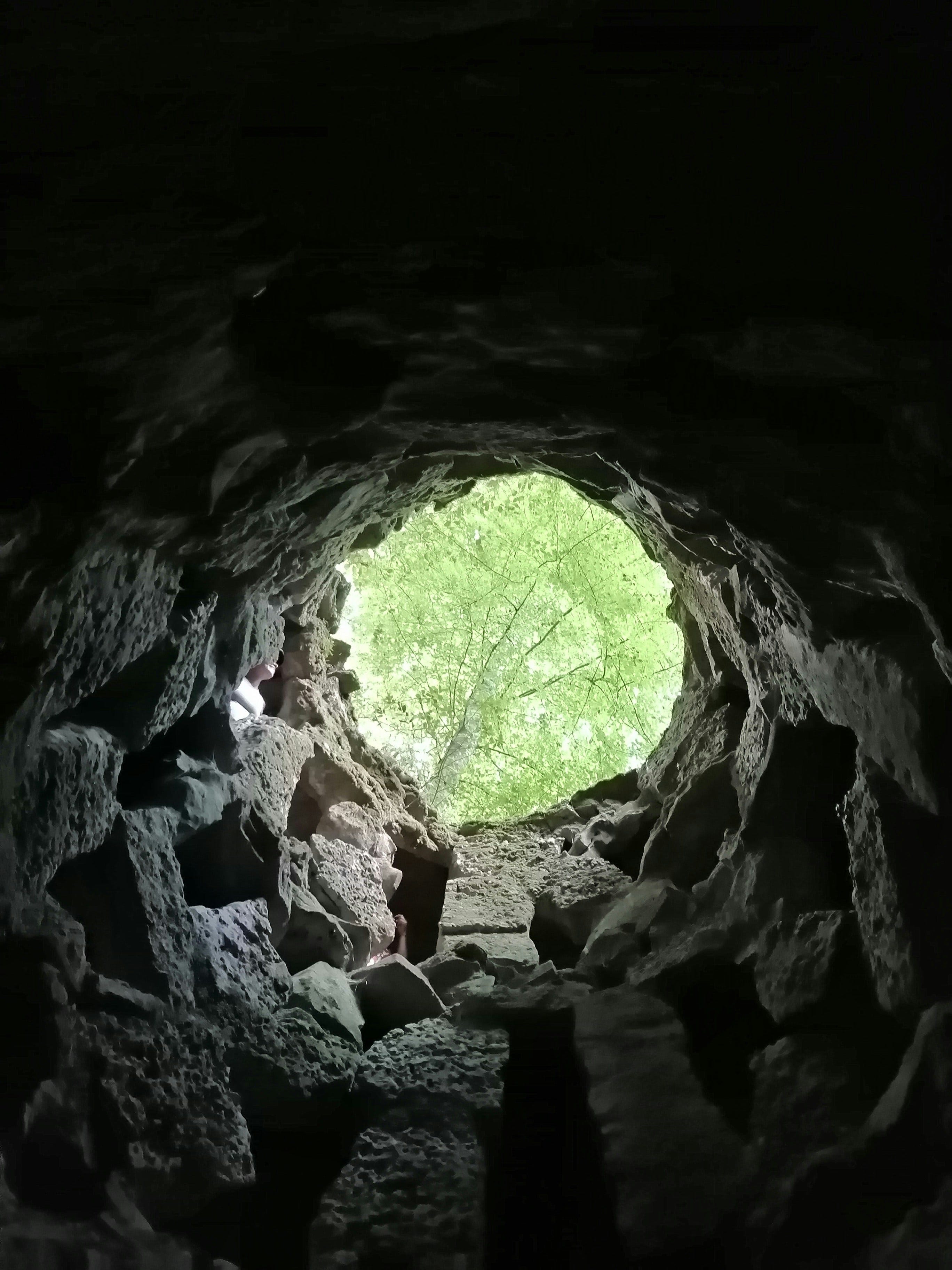
Winding my way around outstretched branches and fallen trunks for what seemed like hours, I saw it for the first time in the flesh. Just as it was in the sketches and photographs I had seen countless times: a small beehive stone dome, built into the side of a low mound. The entrance was more daunting than I expected, all of two feet tall. Looking down, the rutted path came to an abrupt end at the edge of the clearing. Many had come to see down the years, but none dared enter. I would be the first.
Marching forward resolutely, I fixed my headlight on the entrance. From what I could make out, the passageway leading in was roughly three feet long, ending in what appeared to be an oval chamber. Making myself as compact as possible (not easy with a six foot two frame) I crawled through, my nostrils assailed by the strong scent of ancient earth and leaf litter. Slowly but surely I squeezed my way into the chamber, which proved to be fairly high, allowing me to stand fully erect with at least six inches to spare.
Tracing my light over the interior, I could see why some researchers had speculated a potentially Celtic origin for the structure: the well crafted corbelled domed roof being the strongest proof, with no similar construction being found in similar chambers throughout New England. If seeing the exterior had been enough to scare the Irish railroad workers, I could only imagine if they had dared to enter…
A cold and piercing draft from the far end of the chamber shattered my train of thought. Bringing my light to bear, I soon saw what it was that had so disturbed the scout from Enoch Proctor’s company. A passageway hewn out of the stone, with stairs spiraling down into the dark heart of the mound. Immediately above it sat a rough carved but distinctive shape: that of a skull, grinning macabrely, in the manner of a memento mori. Another draft came up from the depths to meet me, rustling my hair. Steadying my head lamp, I followed the call of the unknown.
I had to proceed slowly down the unevenly carved steps, holding onto the damp earthen walls for support. Down and down I went, amazed at the primitive yet impressive feat of engineering. Just when I thought the descent would go on forever, my feet finally hit flat ground. I no longer needed my head lamp for I found myself in a dimly lighted passageway, lined with torch-less, self burning flames.
Creeping up to the end of the corridor, I was forced to stifle a cry: the passage opened up into a long rectangular stone hall, with entry points from all four cardinal direction. In the center tables were tables loaded with all manner of meat, produce, and pitchers. It too was lit by the same torch-less fire, revealing the huddled outlines of robed forms, laughing, singing, and talking with the unmistakable spirit of the season. In a far corner of the chamber a fiddler struck up a tune and was met with a hearty “huzzah!”
The figures - of both sexes, based on their voices - flitted around the expanse, liberally eating, drinking, and dancing. In the corner opposite me, slightly dimmer than the rest, was a sizable pile of lush animal skins, upon which were several writhing, contorting pairs, lost in carnal embrace…
I nearly jumped as I felt a sensuous touch upon my shoulder and a delicate hand placed a carved wooden goblet before my eyes.
“Drink,” the nymph like voice whispered, “and join us.”
Without realizing it I slavishly brought the cup to my lips, relishing the sweet taste of the mead like nectar. A few sips was all it took: not the familiar dulling of the senses brought on by drunkenness, but rather an expansion, of senses I never thought possible…
“Come,” the voice ordered, leading me by the hand towards the carpeted corner.
Before I knew it we were nude, with she astride me, the very picture of an earth goddess: cascading raven hair over breasts like firm apples, fire burning in her amber eyes, full lips uttering unashamed cries of delight, hips moving with learned precision…
Lost to all else around me, awash in animal lust, the scene melted. I was now mounted, melting deeper into her with each movement…
With the climax, all went black. When I came to, the woman laying next to me, I heard the hale and hearty voice of a man speaking to the assembled revelers. With hazy eyes I turned in the voice’s direction. Even with diminished vision I could tell he was tall and broad shouldered, flanked by several smaller, likely female figures.
“Yes, brothers and sisters,” he said. “This season be the true reminder: death is the door, once entered is open evermore!”
The crowd returned the mantra with equal gusto.
“Tis time! Let the procession begin!”
At his order the revelers began lining up, making for the nearest exit. Staggering to my feet, full vision returned. And with it, a scream.
For before was an assembly of corpses. Revenants all, their fluid movement of shriveled flesh and bare bone making an unholy mockery of life.
Before they donned their hoods once more I made out, even with the decay, the distinct facial features of European and Indian alike. And, turning my wild eyes to the leader, I shrank: for it was a ghastly but all too real facsimile of the face of Thomas Marshall, whose dashing portrait I had seen countless times before.
I stumbled forward, trying to escape the way I came, before I was caught by claw like hands -
Only to turn and see my goddess lover, now wrapped in the habiliments of the grave, her face all but a skeleton, hair gnarled and rotten.
“Come,” she said, her voice still airy. “Come through the door of death…”
I wrenched myself free with a mad cry, running pell mell away from that parade of the dead. Flying head long into the first open corridor I saw, I turned a corner only to be met by a wall of hard rock. All went black once more, until I awoke in the morning frost, my nightmarish cries having alerted my aforementioned rescuers, who had been setting up for a day of hunting in abutting state conservation land.
VI
And there you have my tale, take it or leave it as you will. Oh, how I wish I could leave it - but the siren call of my demon lover I cannot dislodge from my brain. For what if that aphorism from the dreaded Liber Mortis is true? “Death is the door, once entered is open evermore!”
And if that was not enough, the news went around town that Aaron Proctor - the last living male descendant of the founding family - was found dead on Christmas morning of an apparent heart attack, around the same time I was near the outside of the chamber. His girlfriend confessed they had arranged for an after hours tryst, but remembering the ancient prohibition, she balked at the last minute, leaving him to face his fate alone. And, I submit, his fate bore the ragged face of Thomas Marshall, at the head of his eternal procession.
© Conor MacCormack, 2025. All rights reserved.
Really enjoyed the narrative within a narrative, the fireside narrator recounting his narrow (literally) escape.
Reading this felt like discovering a lost legend, where Puritan moral rigidity curdles into something far older and darker. Really enjoyed it!