
I
March 21, 1916
As the evening mist took possession of the ancient streets of venerable Providence, Rhode Island, a horse drawn van pulled away from the county courthouse with its looming Gothic spire. Though the automotive revolution had fully commenced - evidenced by the Model Ts lining Benefit Street - the van, with its kerosene lamp illuminating the encroaching blackness, was thoroughly Victorian in aesthetic. Within its oil cloth covered innards, seated on two long rows of wooden benches, was a motley assemblage of shackled reprobates (including unsavory specimens of the fairer sex) garbed in heinously stitched homespun. In the rear of the van sat Deputy Sheriff Noah Colwell, a grizzled but capable law man, while his partner, fresh faced Deputy George Appleby, rode with the recently hired civilian driver.
They were en route to the state penitentiary in Cranston, where the troop of accused (twenty five damnable souls in total) would await their respective trials, possessing nothing close to the means to meet bail. Neither Colwell nor Appleby knew the more grisly details surrounding the case, but had gleaned vague yet unsettling intimations of debauched rustic pandemonium in the rugged northwest reaches of the state. And, even more unnerving in Colwell’s eyes, was the calm - nay, cheerful - countenances of the rogues before him, who treated the rattling ride as a weekend excursion to the country. Before long they had taken up a rather bawdy, macabre diddy, sung with gusto:
“The townsfolk sing, ‘If the mist be slitherin’, open yer skin, spill yer red, and pray the old one back to bed.’”
They raised an even eerier chorus, which sent Colwell unconsciously reaching for his revolver:
“Magna Lupa, Magna Lupa -
Ravenous is she
Mistress of the wild wood
Granting us sweet liberty!”
Overcome with righteous disgust Colwell rose to silence the infernal song -
Only to be gripped by manic hands, suddenly free of their chains.
How in God’s name?! -
Colwell did not go easy, outnumbered as he was. He managed to fell a few of the scoundrels before the rest - let loose by a smuggled key, the glint of which he caught in the lamplight - subdued him. Wrestling his revolver away the lead villain - a tall, broad man with a swarthy complexion - cocked the hammer and fired.
Pain ripped through Colwell as he tumbled out the back of the van, landing sharply. The bullet, which had struck his side, thankfully missed his lungs. Gritting his teeth he rose to an elbow to see the van speed away manically into the night, the horses’ hooves thundering on the road. Several yards behind him he saw a crumpled form, which examination revealed to be Appleby - apparently subdued by the driver, who through some devilish chicanery had worked to spring his confederates from the inside.
Lifting the addled young man to his feet Colwell staggered with him the remaining distance to Cranston, where he informed the prison authorities of the escape. Colwell, his wound less severe than initially thought, and Appleby received basic treatment before reporting to the Sheriff. The prison wireless began buzzing with news of the runaway carriage, barreling down the old Putnam Pike in the direction of Smythefield. The Town Sergeant was immediately notified and a band of special constables sworn in, to meet with the large posse of heavily armed sheriff’s deputies - Colwell and Appleby among them - en route to the town in the dead of night.
The stolen van - with the horses missing - had been found at the foot of the rocky, wooded slope of Wolf Hill. The very place where, twenty four hours prior, the same band of ghouls had been apprehended, engaging in abysmal rites resurrected from the depths of long buried antediluvian aeons.
As Colwell, Appleby, and the rest of the men disembarked from their wagon to join the Smythefield contingent, they were met with a haunting sight: flames dancing on the summit of the hill, where a ring of nude bodies writhed in frenzied rhythm to the same abominable verses, rolling down to assail the ears of that awe struck company:
“The townsfolk sing, ‘If the mist be slitherin’, open yer skin, spill yer red, and pray the old one back to bed.’
“Magna Lupa, Magna Lupa -
Ravenous is she
Mistress of the wild wood
Granting us sweet liberty!”
II
Once part of the original tract of the Providence Plantation deeded to Mr. Williams by that noble Narragansett lord, Canonicus, Smythefield, for all of its rustic splendor, has no shortage of unearthly lore. Indeed, perhaps of all the towns tenanting that wondrous northwestern corner of the state, it continues to prove that there are “more things in heaven and earth” than are fancied possible. And, at the center of it all, is Wolf Hill, that eternal sentinel of the supernatural.
Named for the then dominant wolf population in the region, the hill’s formidable environs were well known to the natives, particularly the Narragansett. When the first English settlers arrived from the bounds of old Providence in the decade before King Philip’s War, they were warned of the Muckquashím-wock (wolves) which roamed the expanse of forested, glacially riven slopes. They were, it was said, the servants of a great spirit or Manittóo, who possessed the hill and did not take kindly to incursions into its domain. The English, in the tolerant spirit of their colony’s founder, heeded the warning to keep the peace.
Yet in the years after Philip’s decisive defeat and Roger Williams’s passing, the tenuous bond of brotherly coexistence between Indian and Englishman gave way to unbridled colonial expansion. As the bounds of the district grew with farmsteads - some nearing the edges of the haunted hill - wolf predations on livestock soared. William Smythe, the town’s namesake and one of its largest landowners, organized a “grand hunt” to extirpate the beasts, starting in 1710. It was executed with brutal efficiency: that is, until, the huntsmen turned their sights toward the long shunned slopes of Wolf Hill.
Setting foot in that terrible wilderness, where stood soaring trees that had never tasted the axe of man, misfortune visited them at every turn. Phantom howls beckoned the would be Orions into the bowels of the forest, from whence they never returned. All efforts to track the packs which continued their raids with impunity came to naught, as they seemingly materialized at will, leaving carnage in their wake. Reports of a titanic wolf with sulfurous eyes, seen perched on the summit at night, began circulating throughout the district.
Such was the fear generated by these happenings that, even with the raising of the colony-wide wolf bounty to thirty pounds in 1739, no one ventured to the eldritch hill to claim what would have been a veritable fortune. Even Israel Putnam, famed for his storied slaying of the last wolf in neighboring Connecticut in 1743, refused the quest.
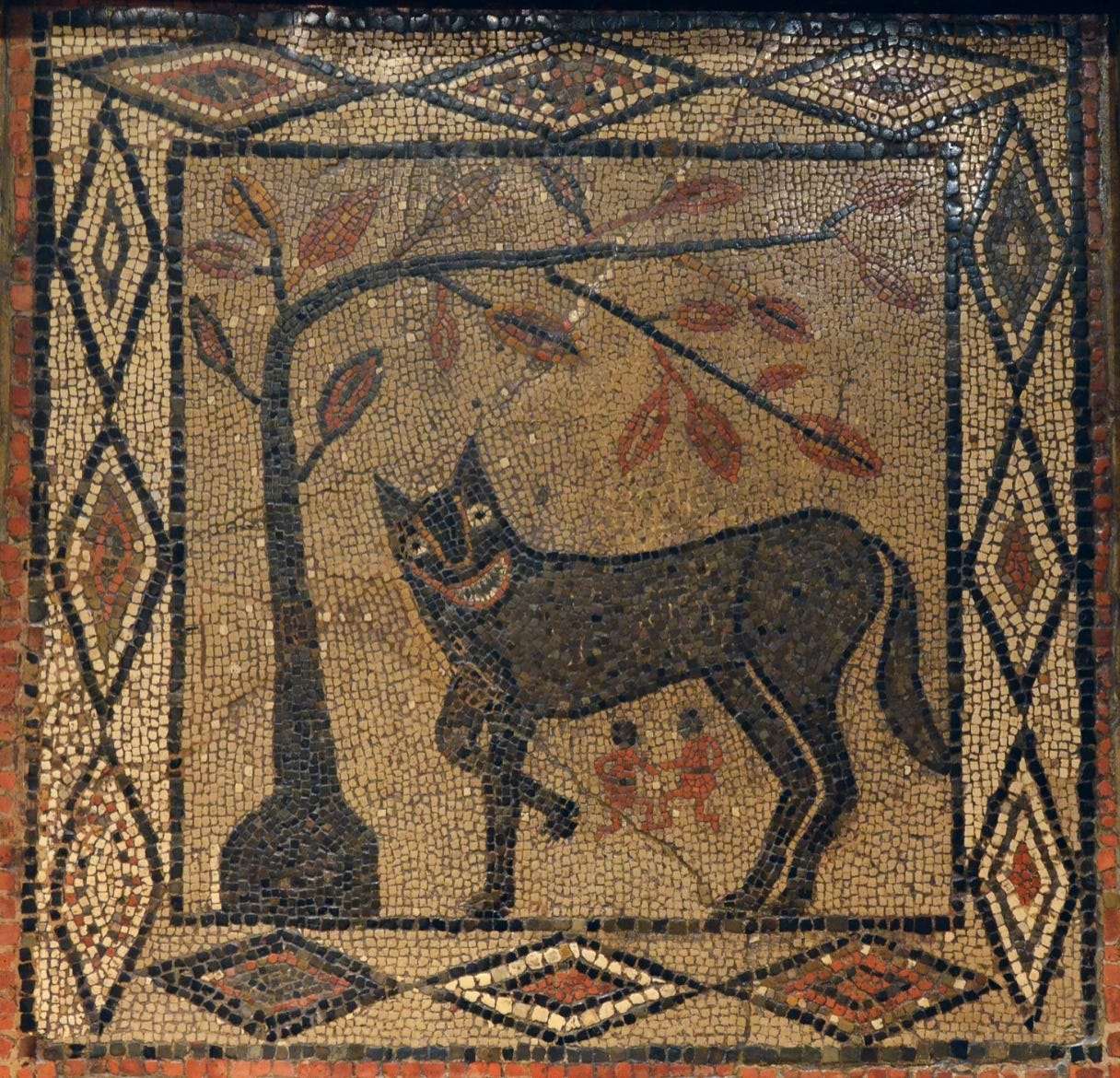
And so that demon denizened ground was left to stand down the ensuing years, held by the Magna Lupa: the title given to the hulking beast, whose dark mystery evoked the she - wolf of Roman legend. And strangely, while blood chilling howls continued to sound from the wooded depths, the once frequent wolf attacks ceased altogether. Though the odd hunter and stalker of the wilds would, by the tavern hearth, relate frightful encounters with the creatures - all of them noting, to a man, the baleful, smouldering eyes.
III
Yet as civilization progressed - with prosperous farms, followed by the humming of river powered mills - around it, Wolf Hill served as an island for the outcast and oppressed. Whether escaped slaves from the sprawling estates of the southern Narragansett Country; Indians seeking refuge from the colonial onslaught; white indentured servants; or, during the Revolution, British deserters, all found reprieve in the enclave known as “Haunted City”. An unlikely mixing, but all were bound together by a common cause of freedom otherwise unattainable among the usual resorts of man. They and their progeny were not known to leave their arboreal commonwealth, their every need seemingly supplied by an invisible Edenic hand.
The townsfolk would have been content to let the queer arrangement become a ghostly relic, used to frighten wayward children, if not for the abominable evidence of their yearly Bacchanalia on the hilltop. Conducted on the spring equinox, when doors and windows were silently barred the length and breadth of the town, the savage sights and sounds were easy enough to block out. But in that fateful late March of 1916, the long latent horror burst forth.
On the evening of the 20th young Leland Waterman stumbled into the parlor of John Arnold, the long serving Town Sergeant, to relate a most dreadful tale. After managing to steady the youth’s palpable nerves with a generous helping of whiskey, Arnold settled in for Waterman’s account.
In tandem with his boon companion, Jenckes Winsor, Leland Waterman had embarked on an afternoon of squirrel hunting, a favorite pastime of the era. Trekking through the woods past the old Farnum Pike the youths, caught up in the thrill of the chase, lost their bearings. Doing their best to reorient themselves despite the oncoming darkness, they only plunged deeper into the rock strewn forest. As they stopped in an attempt to retrace their steps, Winsor spied a strange sight: a stone dwelling, from which the smell of roasted flesh wafted. Waterman balked; he had heard tales of wandering tramps using such remote hideaways as bases for their nefarious deeds. Winsor, who was sorely famished, ignored his friend’s warning and closed the distance. Halting briefly by the open wooden door to cast a beckoning glance towards his comrade, he crossed the threshold.
From which soon came a cry of incomprehensible revulsion, choked off by a sickening thunk.
Waterman snapped into action, raising his shotgun as he advanced -
Only to be gripped with abject terror as a nightmarish, cooing litany rose from inside the damned hut -
“The townsfolk sing, ‘If the mist be slitherin’, open yer skin, spill yer red, and pray the old one back to bed.’”
The voice, dripping with unabashed glee, stirred Waterman to unreasoning flight. Dropping his gun he turned and ran back whence he came, nearly stumbling several times over roots and boulders, mouthing tear tinged prayers to heaven for deliverance. Twice he thought he spied, running parallel with him, monstrous bright eyed bulks on all fours. Through what he termed a miracle he spilled back out onto Farnum Pike just before the curtain of night fell, continuing his mad dash to Arnold’s house.
IV
Arnold, upon the close of the young man’s testimony, poured himself a glass. Having been born and bred in the old town he knew well the whispered tales. And in the course of his long service as Town Sergeant, he had had cause to travel in the vicinity of the hill. Yet nothing could have prepared him for the visceral fright which had marked itself on Waterman’s face as he solemnly and clearly recalled events.
Fancy could conjure much, indeed. But would mere phantasms have made the boy abandon his closest friend - practically a brother to him - in such a forsaken place? Conversely, having regained himself, the resolve Waterman showed in wanting to affect a rescue of his friend was proof enough to Arnold of the boy’s sincerity.
Using his deputizing power Arnold rang up ten of the stoutest, surest men he knew and, along with Waterman, swore them in as special constables. Hitching up his large old farm wagon he had the troop - armed with revolvers and shotguns - pile in for the ride through the gloom.
The unconscious, ancestral fear having gripped the town, their journey was quiet and brooding. Then, as they were within sight of the hill, a sobbing shriek rent the stillness. Riding down the air from the summit - which now glowed with the orange hue of flame - it was soon drowned out by the collective cry:
“Magna Lupa, Magna Lupa -
Ravenous is she
Mistress of the wild wood
Granting us sweet liberty!”
Waterman leapt from the wagon, lamp and shotgun in hand. The agonized call had been Winsor’s: there was no time to lose!
Like a deer he bounded up the slope, deftly dodging rocks and trees. Arnold, despite his age, kept pace as the rest of the men fell in behind. The higher they climbed the more grating became the abominable din, punctuated by animalistic growls and shouts.
Waterman, cresting the hill, dropped his lamp and took aim -
Arnold drew his revolver, bracing himself -
It took all his will not to collapse in a faint. Even the most sordid productions of a Fusili or Doré would have paled before the grotesque scene before him. In a ring of linked arms nude, gyrating figures danced around a roaring fire, bathing the towering trees in a Tartarian light. Behind them an equally unhinged chorus sang the same horrible refrain invoking the “Magna Lupa”. And most appalling of all, set back from the fire, a bisected form hung from a tree, entrails falling into the mouths of -
Wolves. With sulfurous eyes.
Waterman, seized with vengeful fury, let loose a volley on the beasts.
Arnold, keeping his head, fired a warning shot. The revelers surged forward, enraged at the trespass -
The rest of the men opened fire on their would be assailants -
A score of them fell back, running pell mell into the woods. Cries of pain and rage filled the air -
Arnold, clubbing a manic reveler with his pistol handle, was nearly tackled by a hulking wolf. Down to his last round he cocked and fired, sending the monstrosity tumbling into the heart of the fire.
The tumult, while fierce, was brief. Though a number had escaped to the woods, Arnold and his men had managed to subdue twenty five. Five lay dead, as did several wolves, their bodies left to rot on the vile ground. Waterman, bloodlust cooled for the moment, grimly cut down poor Winsor’s remains and covered them with a burlap blanket for proper burial.
Rounding up the heathen - who refused to speak - Arnold extinguished the fire before marching them down the hill at gunpoint. Loaded into the wagon, they were bound with either rope or shackles for the ride to the town jail. There they were crammed like cattle into the three holding cells to await transfer to Providence with the merciful coming of dawn…
V
The combined town and county posse, with Arnold and Colwell in command, girded themselves at the base of the hill for the coming ascent. The noxious incantations had intensified, and the flames now illuminated a gargantuan form, sitting menacingly on its hind legs…
Colwell, gun at the ready, nodded at Arnold and Appleby. Young Waterman stood with fixed eyes on the summit. They were to shoot to kill - man and beast. No quarter. They were too dangerous to be left walking the earth. The primeval perversity would end at last.
Guns were loaded and ready.
The posse scaled the slope…
A hideous cacophony of screams, gunfire, and vicious combat shook the night. The flames rose higher, higher, higher -
A tremendous howl rose on the wind.
All went briefly silent, before the revelers triumphantly sang:
“Magna Lupa, Magna Lupa -
Ravenous is she
Mistress of the wild wood
Granting us sweet liberty!”
© Conor MacCormack, 2026. All rights reserved.
Author's Notes: Being the history buff I am I always try to creatively mesh fact with fiction to make a compelling story. For this tale I leaned heavily into Rhode Island history, a few of facts of which I’ll share below:
Wolf Hill is indeed a real locale in Smithfield (with an I and no E!) and a great hiking spot. It served as a prime wolf habitat before the species went extinct in Rhode Island in the 18th century due to overhunting (due in large part to the substantial bounties offered by the colonial government, as mentioned in the story).
The opening carriage scene was inspired by a real incident which occurred in Providence on the exact same date (March 21, 1916). Two deputy sheriffs were injured in a planned prisoner escape en route to the state prison in Cranston via a horse drawn van. Though most of the escapees were eventually caught, three managed to evade the statewide manhunt to parts unknown.
Muckquashím-wock and Manittóo are just a few of the many words of the Narragansett Indian language which Roger Williams, the founder of Providence, included in his ground breaking work of indigenous linguistics and anthropology, A Key Into the Language of America.
The “Haunted City” of Wolf Hill was inspired by a genuine colonial ghost town in Smithfield: Hanton City. While various theories have been ventured down the years as to the town’s original inhabitants (including runaway slaves, disaffected Native Americans, and British deserters during the American Revolution), it was likely an extension of early English settlement of the region. With the advent of the Industrial Revolution and development of mill villages throughout the Blackstone Valley, the inhabitants of Hanton City likely exchanged a life of hardscrabble subsistence farming for steadier employment in the mills. The other theories, however, are great folklore and make excellent grist for the creative mill.
You have a vocabulary on you. Also, Old West and Rhode Island don’t mix, but I felt that vibe. Also Old West and Model T. But you crafted it well.
It’s hard to beat a good wolfish horror tale. I enjoyed the historical aspect here. I felt like I was dropped right into that era. The dread throughout definitely escalated the final battle on into madness. Well done, Conor.